 Cocoatech
When Keeping Information Wasn’t Enough
In April 2002, during the early days of Mac OS X, Christian Grunenberg and Eric Böhnisch-Volkmann released DEVONthink 1.0. Their small company, DEVONtechnologies, based in south Germany, would go on to create an entire family of applications for collecting, organizing, finding, and working with information, including DEVONagent, DEVONsphere, and DEVONthink To Go.
The original idea came from a problem they knew personally. Both founders had worked in journalism, dealing with large quantities of documents, research materials, and information gathered from different sources. Keeping all that material was one thing. Finding the relevant pieces again, and recognizing how they might relate to one another, was quite another.
They wanted a computer that could do more of that work for them.
Even before DEVONthink appeared, they had developed their own machine-learning technology for analyzing information. The first application grew out of that work.
And rather than simply creating another place to put documents, they began building software that could help people make sense of them. At a time when most software still left the work of organizing documents and recognizing connections between them to its users, this was a pioneering approach.
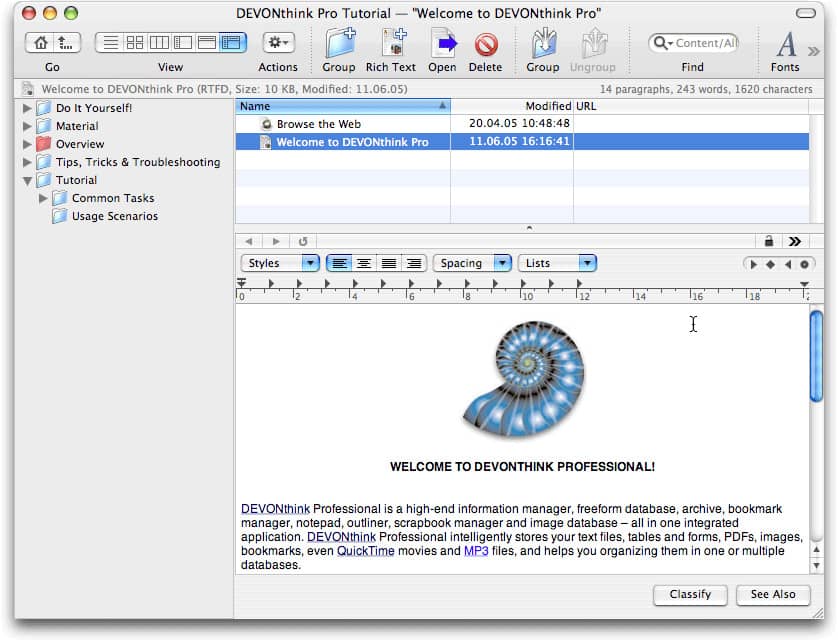
 DEVONthink 1.0
 DEVONthink 2.0

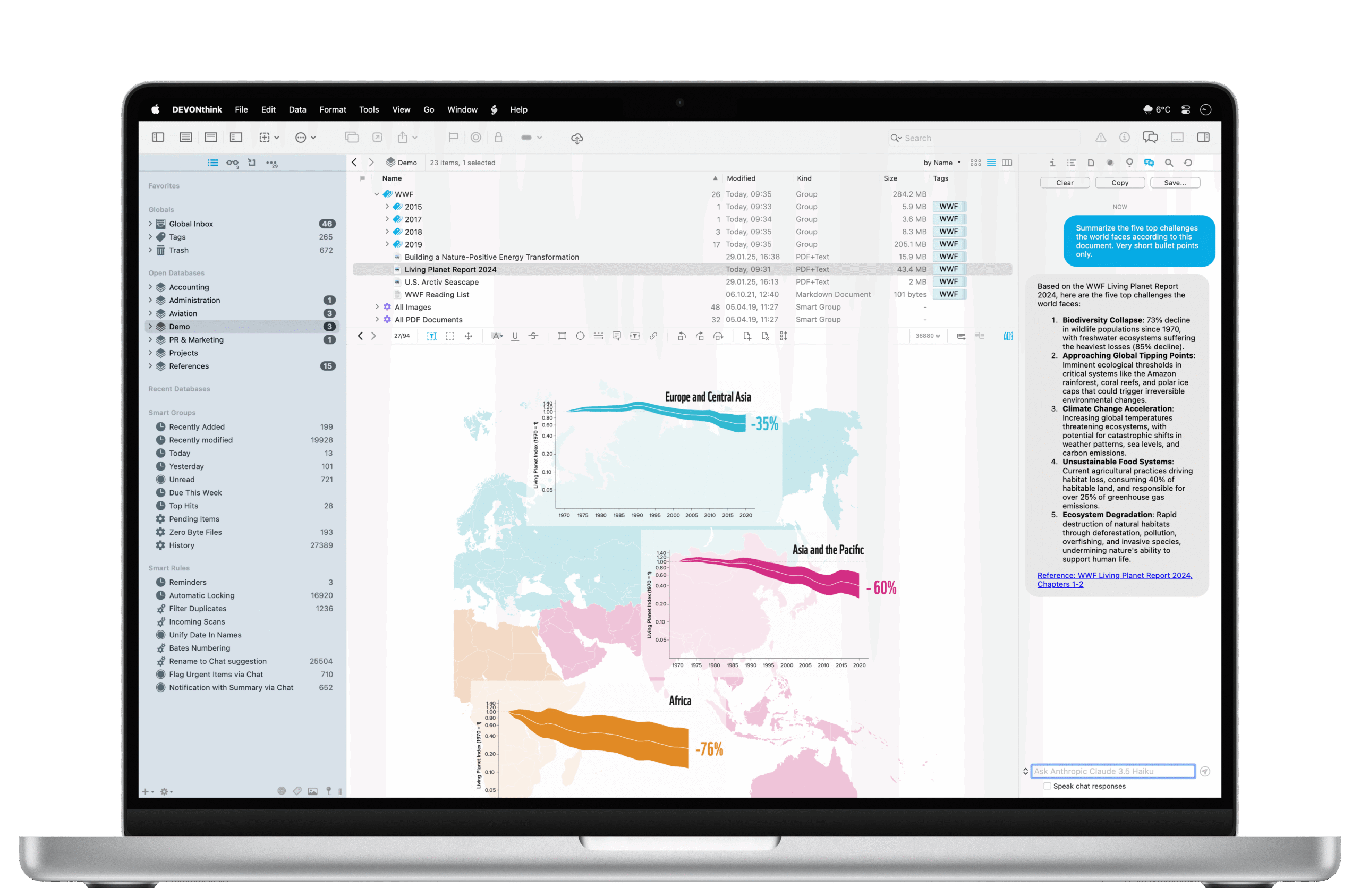
DEVONthink: Your Personal Research Library
Some projects produce more than just a few documents. There are emails, PDFs, notes, spreadsheets, saved websites, and research materials, all collected over weeks, months, or even years. Keeping everything in folders is possible, but working with it as one connected collection is another matter.
DEVONthink was built for people who want more than a place to store those files. It brings different kinds of information together in a searchable library where you can organize documents, annotate them, create links between related materials, and continue working with them. It can even suggest connections between documents that you might not have noticed yourself.
Over time, DEVONthink grew considerably. The original Personal Edition was joined by more sophisticated versions supporting multiple document collections, scanned documents, text recognition, and email archives. Text recognition, called OCR, made it possible to search the words inside scanned pages instead of treating them as pictures.
Today, DEVONthink 4 can visualize relationships between documents using its Graph view and includes modern AI-assisted capabilities alongside the company’s longstanding information-analysis technology.
Visit the DEVONtechnologies website

DEVONsphere: Discovering Connections You Didn’t Know Existed
Finding a document by its name is one thing. Discovering that you already have other documents that are surprisingly relevant to what you’re currently working on is another. Sometimes the most useful document is one you wouldn’t even have thought to search for.
Imagine you’re reading a report about a project you worked on last year. Somewhere on your Mac there might be an old spreadsheet, a saved article, or an email discussing the same subject. You may have forgotten those files exist, not realized how relevant they are, or simply forgotten what you called them.
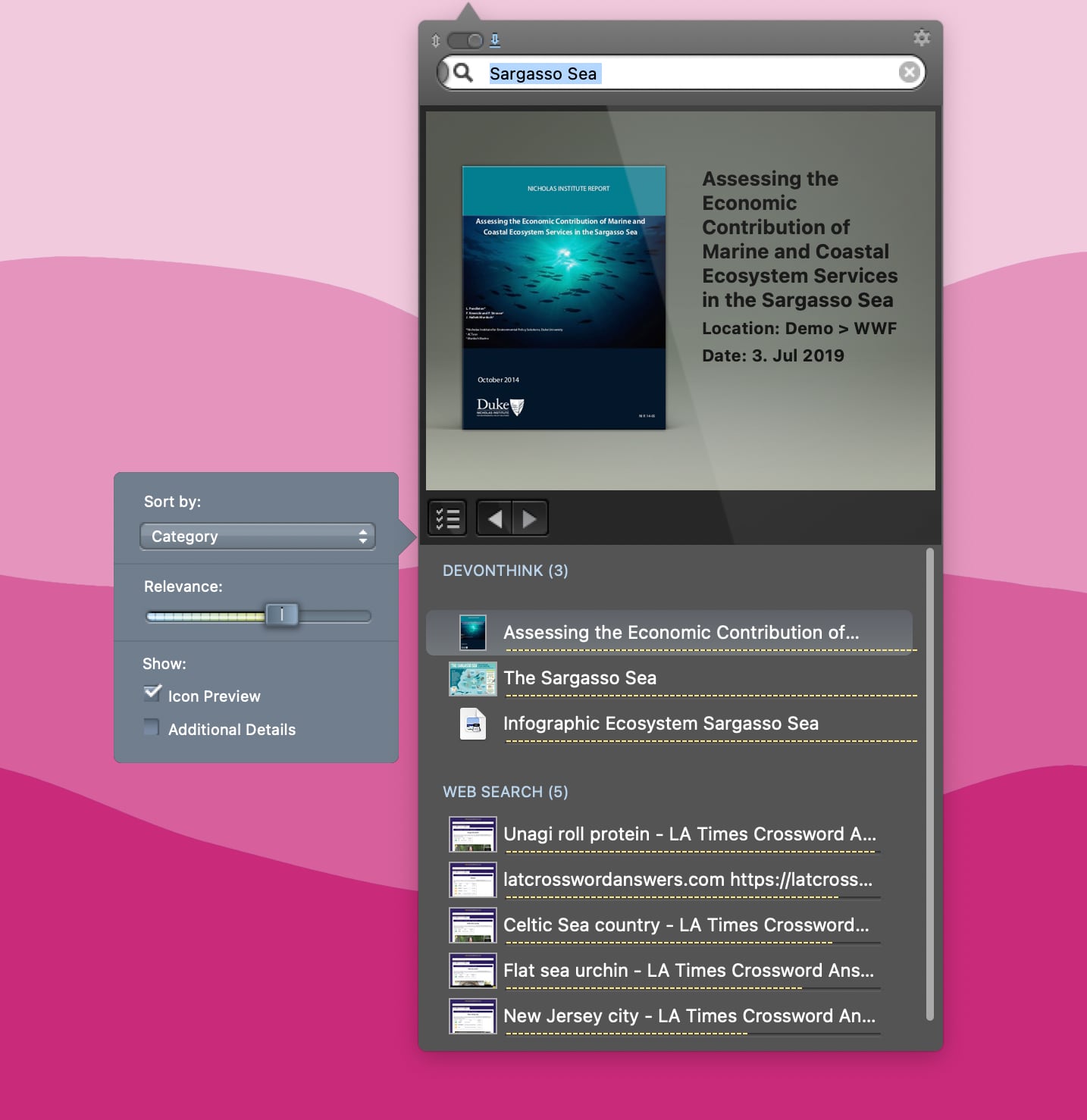
That’s where DEVONsphere comes in. While Spotlight is useful when you already know what you’re looking for, DEVONsphere can take the document you’re currently reading as a starting point and suggest related material you might otherwise overlook. It works from the Mac’s menu bar, helping you discover connections between information scattered across your computer.
Visit the DEVONtechnologies website
An Independent Developer’s Perspective
We asked Eric Böhnisch-Volkmann, co-founder of DEVONtechnologies, what has changed most in developing Mac software over the past two decades, and what has remained the same about the people using it.
Here’s what he told us:
“A lot has changed in how we develop software over the past 25 years. We started with apps only for the Mac, then came the iPhone and soon also the iPad. So what was one app, DEVONthink, had to become a small ecosystem of Mac app, iOS app, and a synchronisation flexible and powerful enough to reliably transport tens of GB of data. APIs came and went, and so did UI paradigms. And now we are in a new world of agentic coding full of whole new challenges.
One thing about our customers that remained constant throughout all these years is their curiosity and their unbroken will to explore new possibilities for extending and polishing their workflow, and for automating tasks using even the wildest possible ways.”
Eric’s description of DEVONtechnologies’ customers made us smile. After nearly 25 years, they’re apparently still finding wonderfully unexpected ways to put the software to work.
And while Mac developers have already navigated decades of changes in hardware, operating systems, and development tools, Eric points to another major shift happening right now: AI agents are beginning to take on parts of the work of building software. Nobody quite knows yet how this will change independent Mac development. But it’s fascinating to see developers who were there at the beginning of Mac OS X now facing an entirely new chapter of software development.
More Ways to Work With Information
DEVONtechnologies has developed several other applications around the same broad problem: DEVONagent Pro helps people research subjects on the web by searching multiple online sources and organizing the results. DEVONthink To Go brings document collections to iPhones and iPads, letting users read, organize, and work with their information away from their Macs.
The company also offers smaller free utilities, including EasyFind for finding files and their contents without first building a search index, and other tools for everyday Mac tasks. Together, these applications reflect an approach that has remained consistent across the company’s history: computers should not simply provide a place to store information, but help people find and work with it.
Celebrating Independent Mac Software
As Path Finder celebrates its 25th anniversary, we’re pleased to introduce our readers to another independent Mac software company whose work began during those exciting early years of Mac OS X.
Black Friday is coming soon, and we’ll be sharing anniversary gifts and special offers from some of the developers featured in this series.
Subscribe to our newsletter to hear more, and we hope you’ll enjoy discovering the applications and the people behind them.